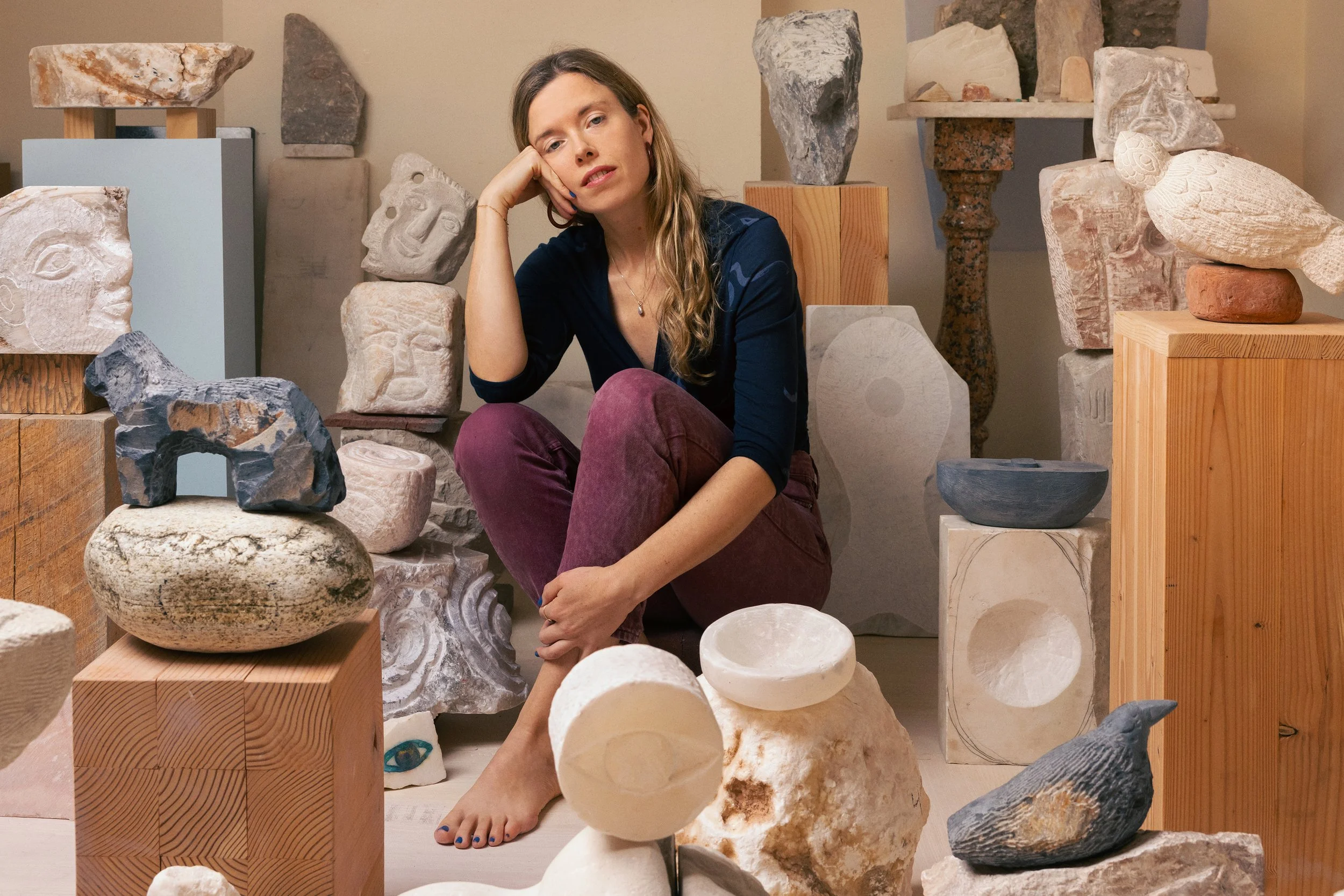
Simone Kearney is an Irish-born, Brooklyn-based artist, writer, and educator. Her multidisciplinary practice moves between sculpture, painting, drawing, poetry, installation, and artist books. Across these forms runs a singular inquiry into how experience takes shape through matter, language, and perception. She approaches making as a process of excavation and attunement — an attempt to locate the unstable threshold where feeling becomes image, where thought thickens into object, and where abstraction remains tethered to the body and the world. Her work consistently dwells in states of emergence: forms are never fully fixed, but instead appear porous, provisional, and in the midst of becoming.
In recent years, stone has become central to this investigation. Across projects such as Runes, Water Stone, Empathetic Geologies, Favorite Stone, and DIGS, Kearney has developed a sculptural language rooted in carving, tactility, and geological time. Working with soapstone, alabaster, marble, rhyolite, earth, watercolor, and text, she creates objects that feel simultaneously ancient and immediate: part relic, part body, part glyph, part emotional residue. These sculptures often appear unearthed rather than authored, as though excavated from some psychic or collective substratum. Veins of mineral color, translucent fissures, sedimentary markings, and the irregular traces of carving remain visible, foregrounding stone not as inert material but as something animate and permeable — capable of holding memory, duration, humor, vulnerability, and transformation within it.
Kearney’s sculptures frequently hover between abstraction and figuration. They resemble masks, compressed bodies, runes, or fragments of an unknown symbolic system, while resisting stable interpretation. Kythe Heller has described Kearney’s work as possessing an ability to move between “the comic, the sacred, and the abject,” and this tension is central to the work’s vitality. Her objects can feel awkward, bashful, sentient, mournful, or absurd all at once. Rather than resolving ambiguity, Kearney sustains it, allowing forms to remain open to projection and association. In this way, her work participates in what Heller identifies as a deeply psychological materialism: an understanding of matter as emotionally and psychically charged.
This sensitivity to material extends throughout Kearney’s broader practice. Earlier sewn muslin paintings, watercolor works, and clay pieces approached abstraction as a form of atmospheric language. Pigment spreads across stitched grids and porous surfaces like weather, memory, or topography, evoking landscapes of thought and sensation without settling into fixed representation. Across clay, fabric, watercolor, stone, and text, Kearney preserves traces of revision, touch, and instability. Her materials sag, stain, fissure, absorb, and accumulate, foregrounding process rather than mastery.
Writing is foundational to this practice. Kearney is not simply an artist who writes, but an artist for whom language itself behaves materially — capable of erosion, sedimentation, fracture, and drift. Her books, including My Ida, DAYS, and Dim, Dahlia, Violet, Stone, extend the same concerns present in the sculptures and paintings: the instability of perception, the permeability of selfhood, and the strange animation of objects and images. Her poems unfold associatively, layering fragments, textures, and shifting voices into forms that feel simultaneously intimate and disoriented. As in the sculptures, meaning emerges through accumulation rather than declaration.
Across all mediums, Kearney’s work is animated by questions of relation: where one thing ends and another begins, how boundaries hold or dissolve, how language and material can both contain and exceed experience. Her practice does not seek to stabilize the world into coherence, but instead to remain close to its instability — to the places where forms are still forming. Whether through carved stone, stitched fabric, clay, watercolor, or poetry, Kearney creates works that feel less constructed than discovered: intimate excavations of consciousness taking shape in matter.
Ultimately, her work acknowledges that touch is our primary site of intimacy, memory, and vulnerability. Because deep emotion is so often bereft of language—pressing physically on the lung or the throat before a word can form—she looks to the hand to read what the eye cannot always parse. By navigating the gray areas between the word and the object, her practice seeks to give form to the unnamable, finding a quiet resonance in the rich, ambiguous spaces where language breaks down and material begins.
Photo credit: Jonathan Grassi